Archive: 2024 · AI & design
That beautiful AI ring still has to be made
Generative images can widen a design conversation, but a wearable ring begins when the picture is tested against real geometry, materials and stone measurements.
- Source context
- Research feature: GIA Gems & Gemology, Fall 2024
- IZIOS review
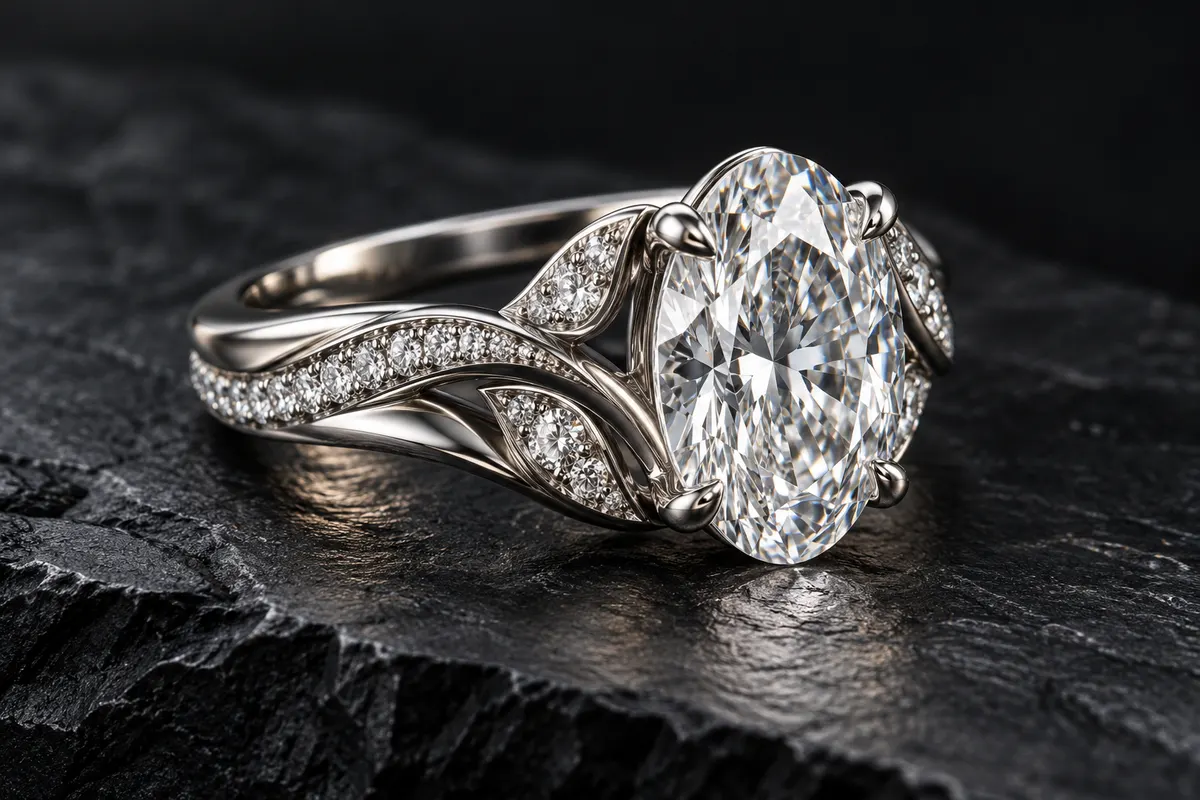
A jewelry image can now arrive before the idea has a name. A few words can produce a ring with a sweeping shank, a halo that appears to float, or a stack of stones arranged like a small piece of architecture. That speed is useful. It lets a person react to proportion, mood and silhouette before committing to a long design brief. The image gives a conversation somewhere to begin. It does not, on its own, describe a piece of jewelry that can be made, worn or repaired.
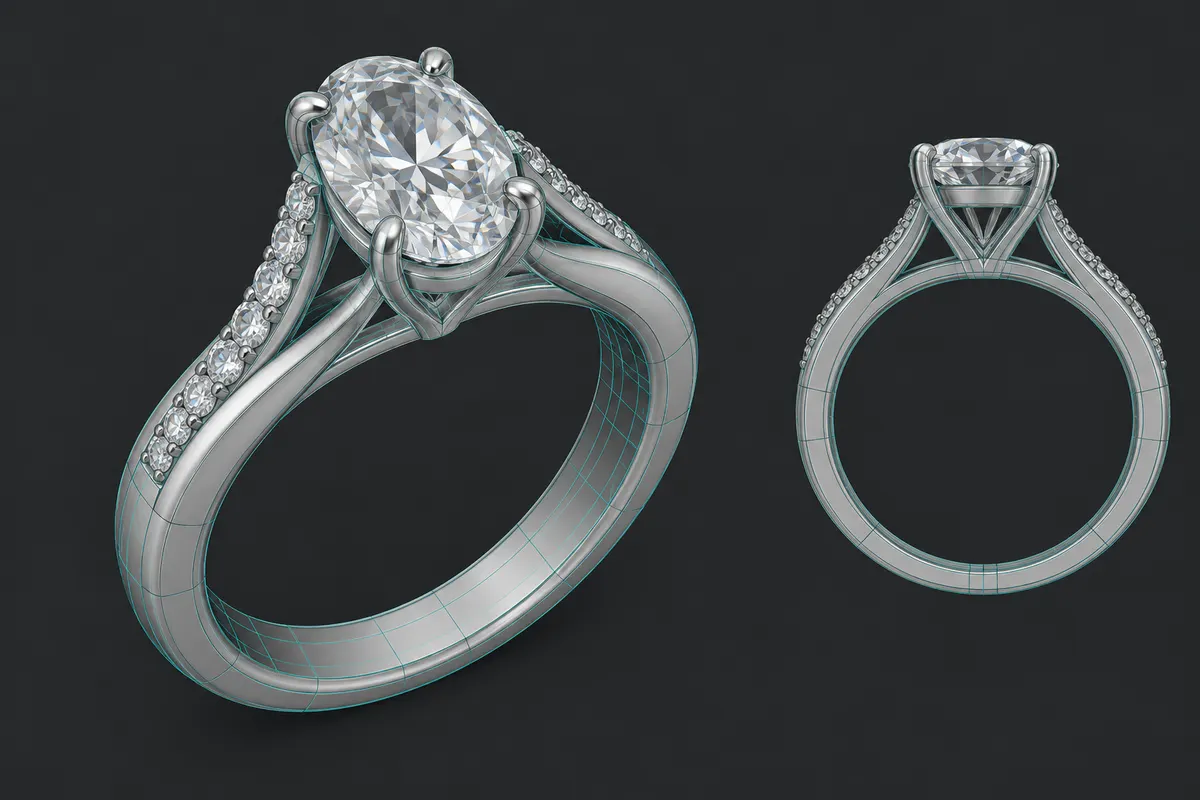
GIA’s Fall 2024 examination of generative AI in jewelry design treats this early exploration as a real use case. It describes rapid variation as a way to develop ideas, while also placing the technology beside the work of turning an image into a physical object. That distinction matters because an image generator is asked to make a convincing view, not to account for every hidden surface, contact point and dimension. A pleasing front view can leave the side view, the underside and the relationship between parts unresolved.
Fitting a real stone
The difference becomes clearest around the center stone. A ring setting has to fit a particular gem, not a generic oval, round or emerald-cut outline. Length, width, depth, girdle shape and the position of the widest part all influence how a stone sits. A design that seems to place a gem low and secure in a render may need more clearance, a different seat or a revised profile once the actual measurements are known. The picture can preserve the visual intention while the construction changes.
Prongs are a small example with large consequences. In a generated image, they may be nearly invisible because unobstructed sparkle photographs well. In a finished ring, they have to reach the stone in a way that holds it, can be finished cleanly and leaves room for routine inspection. The same is true of a thin-looking band, an open gallery or a cluster of accent stones. Delicacy is a design choice; durability, access for cleaning and the way components are joined are engineering questions that an image may not answer.
Turning an image into a brief
This is why a render should be read as a design prompt rather than as a specification. It can be especially good at identifying what someone likes: a north-south orientation, a broad bezel, asymmetry, negative space, a high-contrast metal pairing or a particular arrangement of side stones. Those preferences are useful inputs for a designer. They are not a substitute for a drawing or model that records the intended materials, dimensions, stone sizes and construction decisions.
The visual confidence of an AI image can also hide uncertainty. GIA notes that generated jewelry images can be realistic enough to be persuasive while still containing errors in form and detail. Looking at more than one angle is a practical way to surface those errors. A side view can reveal whether a ring remains balanced, whether the center stone appears protected and whether a design’s height suits the wearer’s expectations. It is not a test of manufacturability, but it is a better question than whether a single image looks finished.
The second draft is physical
A productive custom-design conversation therefore moves in stages. First, collect images for the features that genuinely matter, including the features you dislike. Then identify the intended stone shape and, when possible, the dimensions of the actual stone. A jeweler or CAD specialist can translate the visual references into a model, explain which details need to change and show the result from angles the inspiration image did not cover. That process preserves imagination without asking a picture to carry technical promises it was never made to carry.
The most useful outcome is not an exact copy of a render. It is a ring whose finished proportions still express the reason the image appealed in the first place. Generative AI may make the first draft unusually quick. Physical jewelry still asks for a second draft: one that accounts for the stone, the hand, the material and the life the object will have after the screen is gone.