Historical reference · Stone stories
The blue diamond that changed shape—and names
The Hope Diamond’s route from a much larger blue stone in the French royal collection to the Smithsonian is a history of cutting, evidence and careful attribution.
- Source context
- History · Smithsonian collection records
- IZIOS review
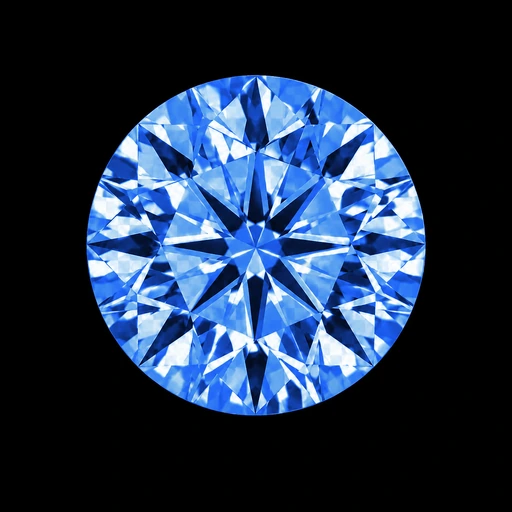
The Hope Diamond is most often introduced as a 45.52-carat blue diamond in the Smithsonian’s National Gem Collection. Its interest, though, is not just its size or color. The stone is a compact lesson in how a famous object can be known through several kinds of evidence at once: royal inventories, later drawings, the geometry of a recut gem, laboratory examination and museum records. Those records do not make every early detail certain. They do show why the modern Hope is more than a jewel with a dramatic legend attached.
A missing jewel and a physical clue
The historical thread begins with a large blue diamond sold to Louis XIV in 1669. Smithsonian collection history describes the source as India, while treating the often-repeated connection to a particular mine as likely rather than proved. Under the French crown, the stone was recut as the approximately 69-carat French Blue. After the French crown jewels were stolen in 1792, a smaller blue diamond appeared in London in 1812. The sequence supplies a plausible lineage, but a date sequence alone cannot establish that two differently shaped gems are the same stone.
That is where the physical record changes the story. A lead cast of the French Blue, discovered in Paris in 2007, gave researchers a three-dimensional reference for the missing crown jewel. Computer modelling based on that cast showed that the present Hope could have been cut from it. The Smithsonian’s account treats the cast, the later form and the historical chronology as mutually reinforcing evidence. The important point is methodological: provenance here is not a single anecdote but a case assembled from records that answer different questions.
Recutting is the bridge between the names. A cutter can alter outline, remove weight and change the visible facet pattern; a later observer may therefore encounter a stone that does not resemble an earlier illustration at first glance. Yet recutting also leaves constraints. The material available, the direction of the cut and the proportions of the later gem limit what transformation is possible. That is why a model based on the French Blue cast is more informative than a simple comparison of color or a story about ownership.
What makes the Hope blue
The physical stone has its own evidence trail. GIA’s research on natural blue, gray and violet diamonds identifies the Hope as a Fancy Deep grayish-blue diamond and attributes its color to measurable boron in a type IIb diamond. The study places that color mechanism within a wider scientific picture: blue appearance can arise through more than one defect pathway, and boron-bearing natural diamonds are only one group within the blue-to-violet range. A famous name does not turn color into a single, universal phenomenon.
That distinction matters when people use famous stones as visual shorthand. The word blue describes an appearance, but gemologists also ask what produces it, how it is distributed through the crystal and how the stone responds under examination. GIA notes that boron-related type IIb diamonds can show phosphorescence; the Hope is a celebrated red-phosphorescing example. These traits enrich the scientific identity of the Hope. They are not a shortcut for identifying another blue diamond, whose color may have a different origin and whose documentation must stand on its own.
The object in the collection
The Smithsonian’s object record supplies a more prosaic but equally useful correction to familiar lore: the Hope was removed from its setting and weighed at 45.52 carats in 1975. The museum also records Harry Winston’s 1958 donation, which moved the stone from private ownership into a public collection. Museum custody did not freeze the object in a single presentation; the Hope has been examined, set, unmounted for exhibition and studied over time. Its public history is therefore also a history of changing access to the object itself.
The 1958 gift and the later scientific work illustrate two different kinds of public value. A collection record establishes where an object is held and how it can be cared for. Gemological research tests material properties that stories cannot settle. Historical research connects documents to the physical object without pretending that every missing link has been recovered. Read together, those forms of evidence make the Hope more interesting than a tale built from a curse, a price tag or a fictional conversation.
The stone was recut into a new form, and it later acquired the Hope name through its ownership history; its identity became more secure because evidence accumulated. That makes it a useful historical case for any viewer of gems. Color, cut, setting, origin and provenance are related, but they are not interchangeable. A stone can be beautiful before its history is complete, and a careful account remains stronger when it marks the line between what the evidence shows and what it merely suggests.
Primary sources
- Smithsonian National Museum of Natural History: History of the Hope Diamond
- GIA Gems & Gemology: The French Blue and the Hope, Spring 2009
- Smithsonian National Museum of Natural History: Hope Diamond object history
- GIA Gems & Gemology: Natural-Color Blue, Gray, and Violet Diamonds
- Smithsonian Institution: Hope Diamond presented to the National Museum of Natural History