Current reference · Gold
What the gold price tells you about a ring—and what it leaves out
Work through the metal in a simple band, then follow the design and workshop decisions that turn it into a finished piece.
- Source context
- Retail price explainer reviewed November 1, 2026; no live price quotation
- IZIOS review
Gold falls on the market, but the ring you saved last week still has the same price. It can feel as though one of those numbers must be wrong. The explanation starts with what each number measures. The gold chart tracks a material. The ring price includes that material in a particular object, together with the work and business costs of getting it onto someone’s hand.
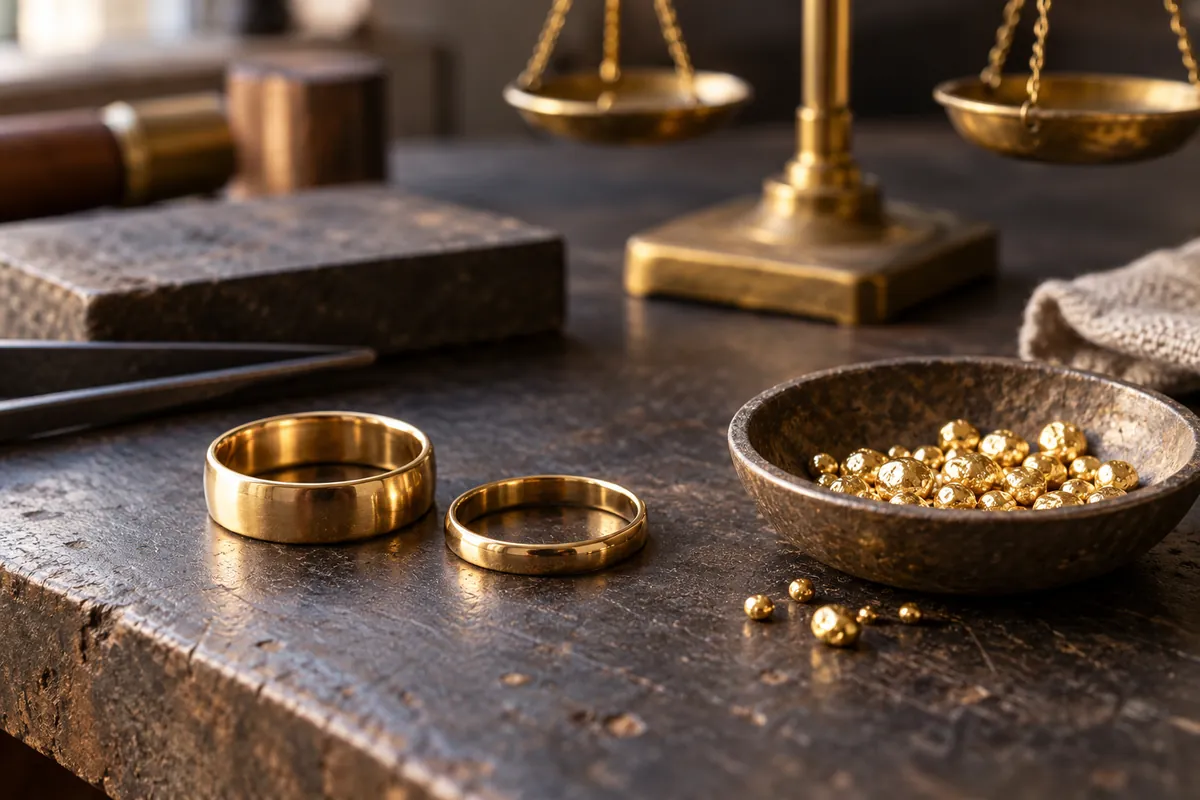
The distinction is easier to see with a plain band than with a diamond ring. There is no center stone to complicate the comparison, but the band still has a width, thickness, profile and finish. Two yellow bands photographed from above might look nearly identical while containing different amounts of gold alloy. A domed outer surface can conceal a lighter interior; a wider profile may use more metal even when the finger size is the same.
The gold inside the alloy
Start with the alloy. Karat expresses gold content in twenty-fourths: 18K is 18 parts gold out of 24, or 75%; 14K is 14 out of 24, approximately 58.3%. The remaining portion consists of other alloying metals. As the Federal Trade Commission’s jewelry guidance explains, the quality mark describes gold content. It does not tell you how many grams the object weighs or how much work went into it.
Consider a hypothetical band whose metal weighs four grams. At 18K, it contains three grams of fine gold. At 14K, the same metal weight contains approximately 2.33 grams. If a hypothetical fine-gold reference were $100 per gram, the gold component would calculate to about $300 or $233 respectively. These are arithmetic examples, not current prices. They put a scale on the metal difference without pretending to quote a finished ring.
Now suppose that hypothetical gold reference rises by 10%. The fine-gold component of the four-gram 18K band rises from $300 to $330. That is a $30 change in one component of the cost, not an instruction to raise the whole retail price by 10%. The calculation helps explain why a movement in bullion and a movement in jewelry prices need not match, even when the metal is an important part of the piece.
A real comparison also has to use consistent units. Precious-metal charts commonly quote a troy ounce; a ring specification may use grams. The currency and time of the quote matter as well. The Royal Mint’s price charts distinguish market references from the prices at which physical products are bought and sold. A screenshot stripped of its unit, date or buy/sell context can make an apparently precise comparison surprisingly unhelpful.
What happens at the workbench
The next step is the work. Even an unadorned band needs its intended shape, a comfortable inner surface and a finished exterior. A ring with stones adds seats and settings that must suit those stones. A custom design may require time spent resolving its proportions before metal work begins. Those tasks do not become 10% quicker because the gold reference falls by 10%. Their contribution also varies between designs and workshops.
This is why a detailed description is more revealing than a single purity mark. Imagine comparing a wide, light band with a narrower, heavier one. The wider ring may provide the look someone wants; the heavier one may feel different on the hand. Neither comparison can be settled by announcing that both are 18K. Width, wall thickness, metal weight and construction explain what is actually being offered.
For a diamond ring, it helps to understand the setting and the center stone separately, even if the seller gives one total price. A change in the stone’s dimensions may call for a different head or setting design. A change in finger size or band width can alter the metal requirement. The original quote describes a particular project; it is not necessarily a price for every variation of the photograph.
A finished object has more than one value
There is a similar distinction when jewelry is resold. A buyer interested mainly in recoverable metal is answering a different question from a customer commissioning a finished design. The original retail price paid for work, service and the completed object as well as material. A gold-content calculation therefore offers useful context, but it is not a buyback promise or a measure of the piece’s sentimental value.
The most useful role for a gold chart is modest and specific. It helps explain the material environment in which a quote was made. The quote itself should explain the ring: its alloy, dimensions, construction, stones and included work. With both in view, a price change becomes something you can discuss in concrete terms rather than an argument over whether a ring should move in lockstep with a line on a screen.