Current reference · Silver
Silver at the workbench: what a market price means for sterling jewelry
Silver belongs to both industry and jewelry. Understanding sterling, construction and fabrication helps connect the market story to a piece you can wear.
- Market data period
- 2025 actuals, reported in April 2026
- Source publication date
- IZIOS review
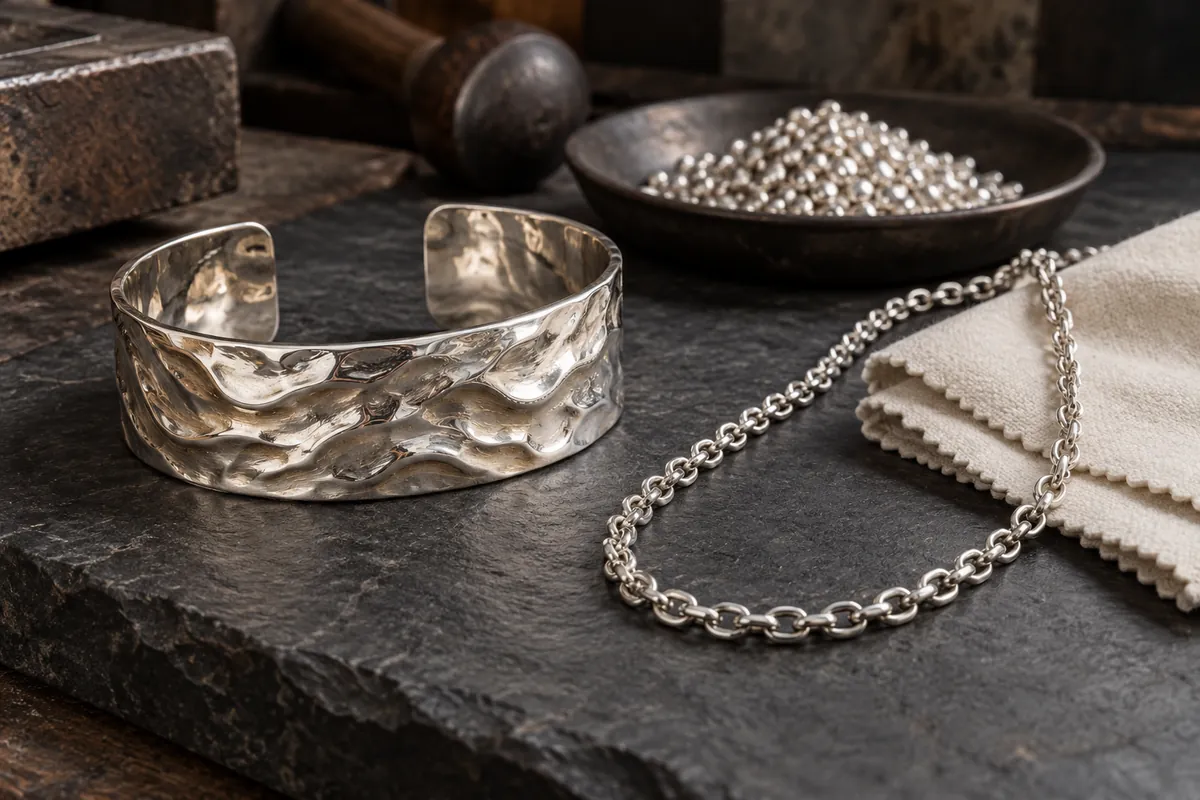
A silver cuff and an electronic component have very little in common as finished objects. Yet silver demand from outside jewelry is part of the market in which that cuff is made. This is one reason a precious-metal headline can feel distant from the pieces in a jeweler’s window. It follows a much larger set of uses than necklaces, rings and bracelets.
The wider silver market
The Silver Institute’s World Silver Survey 2026 gives a useful dated snapshot. Its April 15 release reported 657.4 million ounces of industrial demand in 2025, down 3% from the previous year, and a fifth consecutive annual market deficit. The report describes several forces acting at once, including investment and movements of available metal. It is an account of that period, not a shortcut to predicting the price of silver today.
A market deficit means reported demand exceeded supply over the measured period. It does not mean every workshop ran out of silver or every shop sold more jewelry. Stocks and the availability of metal in different places also matter. At the scale of a single piece, it is more useful to ask how much material the design contains and what has been done with it than to translate a global deficit directly into a retail price.
What 925 tells you
Sterling gives the material discussion a starting point. The FTC explains that sterling silver is 92.5% silver and may carry a 925 mark. The remaining 7.5% is alloying material. A hypothetical 20-gram piece made entirely from sterling alloy would therefore contain 18.5 grams of silver. That calculation assumes the weight is metal only; a stone, non-silver fitting or other component would need to be accounted for separately.
Silver plate describes a different construction: a layer of silver over another material. A bright surface in a photograph does not tell you whether the object is sterling throughout or plated. Neither description, by itself, explains the quality of a design. It does explain why two silver-colored pieces should not be compared as though they contain the same material. The distinction belongs in the description before the discussion turns to price.
Construction can be just as consequential. Picture two cuffs with the same outline. One might be made from a thicker section of metal; another might achieve its size with a lighter construction. Their feel, weight and suitability for a particular wearer can differ. For chains, the dimensions of the links, their assembly and the clasp all contribute to the finished object. A photograph gives only part of that information.
Then there is the surface. A highly polished curve, a deliberately textured face and an oxidized detail are different design choices, even when the underlying alloy is the same. They change how the piece looks at arm’s length and close up. They also make the maker’s care instructions worth keeping: cleaning intended to brighten every recess could work against a design that deliberately uses darker areas for contrast.
Material, workmanship and price
This is where the market story and the workshop story meet. If the silver component becomes more expensive, it can affect the material cost of a piece. It does not tell you how long a maker spent developing the shape or finishing the surface. A simple heavy object and an intricate light one can allocate their cost very differently. Weight is informative, but it cannot stand in for a description of the work.
Consider a hypothetical comparison between a 20-gram and a 10-gram sterling piece. At an identical fine-silver reference, the first has twice the silver content. It does not follow that its finished price should be twice as high. The lighter piece may involve different construction or more detailed work. This is not a defense of any particular markup; it is a way to identify what a fair comparison would need to include.
It also helps to separate a new-jewelry purchase from a later resale offer. A retail price describes a finished object and the transaction around it. A resale buyer may be interested in the design, the maker, the condition or mainly the metal. The original price and a current silver quote cannot tell you which of those interests will determine a future offer.
Silver is worth following because its story reaches well beyond jewelry. A sterling piece is worth looking at closely for the opposite reason: its particular form, finish and construction matter. The 925 mark tells you something useful about the alloy. The rest of the description should tell you what the maker has made from it.