Historical reference · Lab-grown diamonds
Before the engagement ring: the industrial beginnings of lab-grown diamonds
The first commercially useful laboratory diamonds were tiny industrial crystals. Turning that achievement into jewelry required a different set of breakthroughs.
- Source context
- Historical feature reviewed November 1, 2026; 1950s breakthroughs and later jewelry development
- IZIOS review
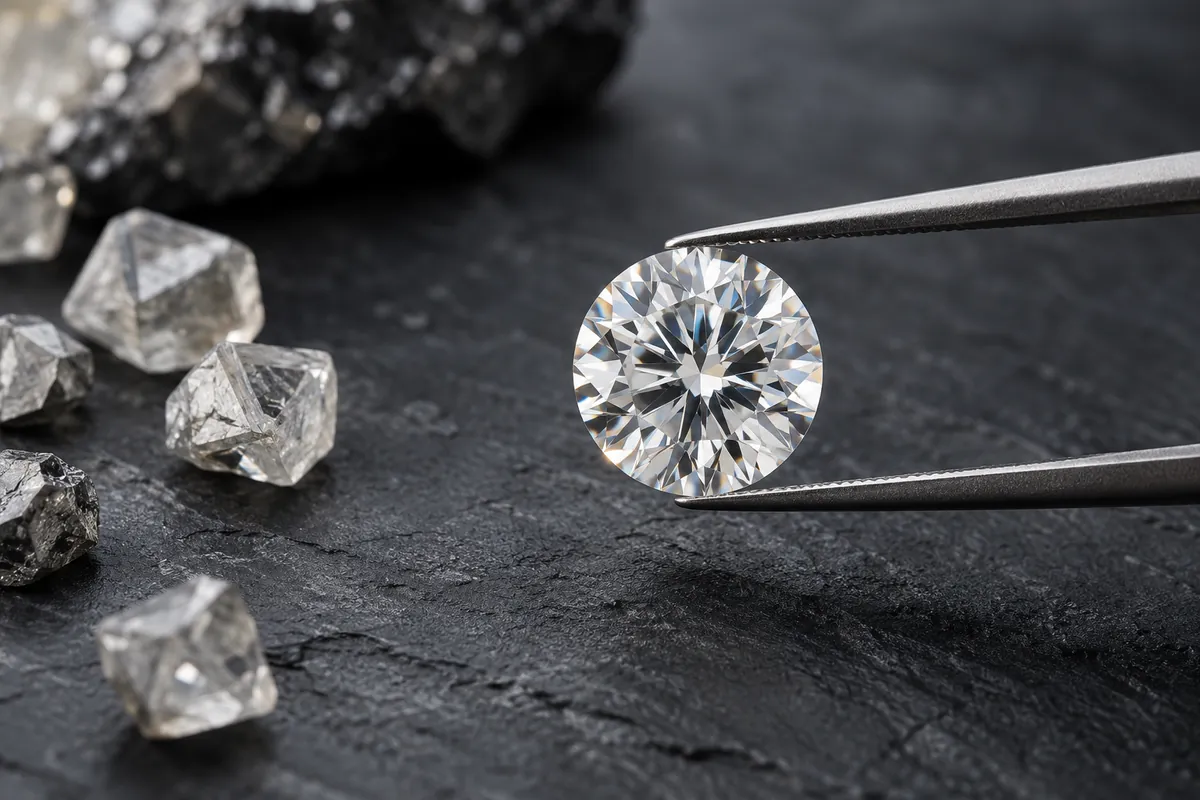
The laboratory-grown diamond story begins with crystals that would have made an unpromising engagement ring. They were small, and the early commercial material was often brown. Beauty was not the immediate objective. Researchers were trying to make diamond reliably, and industry could use it without needing a transparent crystal large enough to become a polished gem.
That distinction makes the history more interesting than a single invention date. Producing diamond, growing a gem-quality crystal and manufacturing jewelry at a workable cost are separate achievements. A process can succeed scientifically long before it makes sense at a jewelry counter. Each stage asks a different question: is this diamond, can it be cut into a desirable stone, and can it be produced consistently enough for a market?
Two routes to diamond
GIA’s historical account places early CVD and HPHT successes close together in the 1950s. William Eversole produced tiny CVD diamonds in 1952; ASEA achieved HPHT growth in 1953; General Electric’s work followed in the same period. The account describes the early GE output as small brown industrial diamonds. The familiar modern growth labels therefore have histories extending well before laboratory-grown diamond became a common jewelry category.
The initials describe different approaches. HPHT stands for high pressure and high temperature. CVD stands for chemical vapor deposition. In both cases, the result can be diamond: carbon arranged in the diamond crystal structure. The laboratory origin distinguishes it from natural diamond. Moissanite and cubic zirconia, by contrast, are different materials that can be used to resemble a diamond’s appearance.
From a specimen to a product
The next milestone was not simply more of the same material. GIA describes General Electric’s gem-quality developments announced in 1971, including small polished stones submitted for examination. They demonstrated that material suitable for gems could be made. The equipment and production demands still made those early examples economically impractical for jewelry. A successful specimen did not immediately become a repeatable retail product.
That gap between a demonstration and a product is easy to overlook when looking backward. A jeweler needs more than evidence that one attractive crystal can exist. The material must yield usable stones with specifications that can be described and compared. Cutting, grading, distribution and the setting itself remain separate work. Growing the crystal answers the question of origin; it does not finish the ring.
The history also explains a word that still causes confusion: synthetic. In gemology, synthetic diamond refers to laboratory-produced diamond, not simply any clear imitation stone. In everyday speech, people sometimes use the word more loosely. A useful description makes the material explicit. ‘Laboratory-grown diamond’ and ‘cubic zirconia’ tell a reader more than ‘real’ and ‘fake,’ which can collapse several different questions into an argument about vocabulary.
Identity, origin and the individual stone
Those questions include identity, origin and quality. Is the material diamond? Did it grow naturally or in a laboratory? What are the characteristics of this particular stone? The first two answers do not determine the third. Two diamonds from the same growth category can still differ in their dimensions, color, clarity and cut. A category label is the beginning of a description, not a complete account of the individual gem.
A photograph answers another kind of question. It can help show how a cut stone looks in that lighting and view, but it cannot reliably establish its growth history. Laboratory identification uses testing beyond what a shopper can see in a listing image. A report and a video therefore have different jobs: the report records the laboratory’s findings, while the video offers a view of the particular polished object.
The same distinction matters when discussing treatment. Growth method describes how the crystal formed; subsequent treatment, where present, concerns what happened afterward. A precise account does not use one term as a substitute for the other. The relevant laboratory’s report and explanatory material are better places to resolve that history than a visual guess based on whether a stone looks especially clear or bright.
Seen this way, laboratory-grown diamond has two connected histories. One follows the ability to make a useful material under controlled conditions. The other follows the development of crystals that could become wearable gems. The small industrial diamonds were not failed jewelry. They were successful answers to an earlier problem—and the starting point for a much longer story.