Historical reference · Diamond history
Looking closely at old mine and old European cut diamonds
A small table, a tall crown and an open culet give older cutting styles a distinctive appearance. Here is how to look at those details without confusing style with age.
- Source context
- Historical design reference reviewed November 1, 2026
- IZIOS review
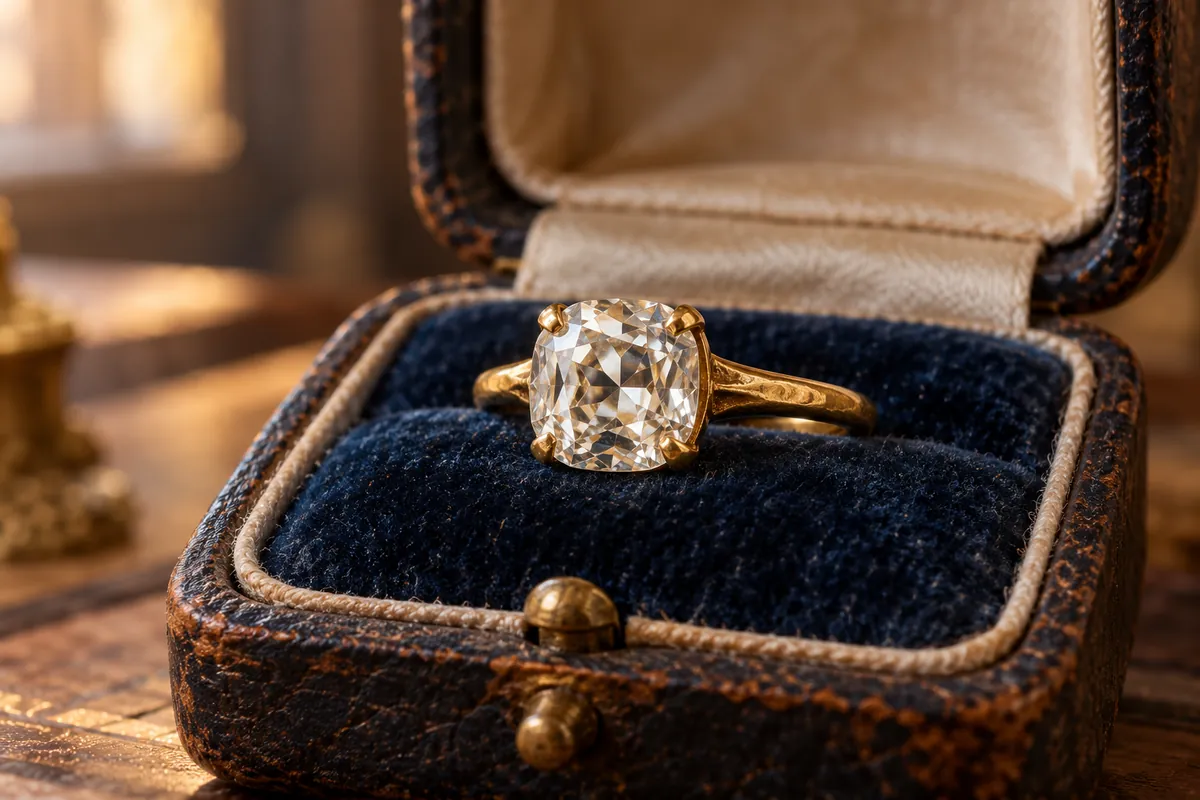
Look into some antique-style diamonds and a small shape appears at the center, where you may expect an uninterrupted pattern of facets. Often you are seeing the culet: a facet at the bottom of the stone, visible through the top. It can look like a tiny window. Once you notice it, an older cutting style begins to read differently from a modern round brilliant.
The culet is one detail in a larger set of proportions. The table is the broad facet on top. The crown rises above the widest part of the stone; the pavilion extends below it. Changing the relationship between those parts changes the object you see from above and from the side. The outline gives the stone its first impression, but it does not describe the whole cut.
Reading the proportions
GIA’s old mine cut guide describes a softly squarish outline, a small table and a relatively large culet. An old European cut has a rounder outline and, in the comparison given by GIA, a smaller culet. The old European style is a predecessor of the modern round brilliant, with a comparatively high crown and greater total depth. These features help explain why older styles can have a presence that is not captured by carat weight alone.
A useful way to compare the two is to look at the outline first, then the center and finally the profile. The rounded square of an old mine style can suggest a cushion; the old European outline leads the eye toward a circle. The table and culet then give each example a different internal pattern. A side view reveals proportions that a face-up photograph may hide.
That sequence is more informative than relying on a single romantic adjective. ‘Chunky,’ ‘soft’ and ‘vintage’ may communicate a preference, but two people can mean different things by them. One may be responding to the outline, another to broad areas of reflection, and another to the setting around the stone. Identifying the feature makes it easier to explain what you like and to recognize it in another example.
Style and age are different questions
It also prevents a common confusion: an antique style is not the same thing as an antique object. A newly cut stone can draw on older proportions. An old ring can contain a replacement stone. A modern cushion is not automatically an old mine cut just because its corners are rounded. The cutting description and the account of the object’s age need to be considered separately.
For a historic piece, the setting adds another layer. Its construction, alterations and condition belong to the story of the ring, but they do not necessarily date every component to the same moment. A family may have reset a treasured stone or replaced a damaged part. That history can be interesting in its own right. The important thing is to describe what is known rather than force the whole object into one convenient date.
For someone drawn primarily to the appearance, there is no need to make an age claim at all. A contemporary design can use a high crown, a visible culet or a softly squared outline deliberately. The brief becomes more precise when it names those features. ‘I like the open center and the taller profile’ gives a designer more to work with than asking for a ring that simply looks old.
Seeing the stone in a ring
Seeing the stone move is useful because a still photograph selects one instant. Ask for views that show both the face and the profile, and notice how the pattern changes as the stone turns. Different lighting can reveal different aspects of the same cut. This is an opportunity to decide whether you enjoy that individual stone’s appearance, rather than to prove that every example of a named style performs in the same way.
The setting deserves the same attention. A tall stone and a low-profile ring design may require a compromise; a mount can also conceal details that were visible when the stone was loose. Comparing the proposed ring as a whole helps keep the discussion grounded in what will actually be worn. A close-up of a loose diamond is compelling, but it is not the final view from a wearer’s hand.
Older cutting styles offer a different vocabulary for looking at diamonds. They invite attention to the outline, the center, the crown and the object’s history, rather than reducing the decision to a familiar shape name. Whether the piece is a documented antique or a newly made interpretation, those specific details are where its character begins.